Monday, June 21, 2021

Values

 I recently listened to Brene Brown. To be honest, I disagree with some of what she had to say, but I liked her https://daretolead.brenebrown.com/wp-content/uploads/2019/02/Values.pdf worksheet.


The idea that most people have two values or traits that drive them is pretty spot on. I've been using a variant of that as a replacement for alignment in some games.

But I was reflecting on that recently. I'd bet that my wife is right when she says my personal motivating values are curiosity and loyalty.

Her values are diligence and kindness. I was reflecting on that as I thought about the three things I used to tell my kids.

Be kind, work hard, tell the truth.

It hit me that while I'm motivated by curiosity and loyalty, I value kindness and diligence, if that makes sense. And it is no surprise that the two I value the most are the two that define my wife.

It has been giving me thought.

For game (and conflict resolution -- see adrr.com) purposes, I have been defining values in the trait pairs.

Traits:

  1. Chaste.......  /.....Lustful
  2. Energetic.... /.....Lazy
  3. Forgiving.... /.....Vengeful
  4. Generous... /.....Selfish
  5. Honest......  /.....Deceitful
  6. Just.........    /.....Arbitrary
  7. Merciful....   /.....Cruel
  8. Modest....... /.....Proud
  9. Pious........   /.....Worldly
  10. Prudent.....  /.....Reckless
  11. Temperate  /.....Indulgent
  12. Reliable....   /.....Feckless
  13. Trusting....  /.....Suspicious
  14. Valorous...  /.....Cowardly

But, in Mistworld, I really have positive versions and twisted or malfunctioning versions.

Eg.  Brave .... / .... Cautious would be the real replacement for 14, above, with;

   Foolhardy .../ .... Cowardly as the twisted versions.  That allows me to recognize that there is a positive form of valorous and a negative form, a positive form of cautious and a cowardly form.  It perhaps means that the list needs some modification (e.g. Prudent/Reckless overlaps with Foolhardy/Cowardly).  

I've been using the system by having players pick five of these (out of 28) to define their characters, with one that is more significant than the others.  I probably need to rethink the list somewhat and work out each of the pairs into sets of two pairs (the positive and the negative versions).

But I'm rethinking it all.

Monday, January 25, 2021

Dragons in Glorantha

An old fragment from a Kachina recitation from the Blue Moon Plateau.

Dragons begin with Dragonewts and Dragonewts begin with the left handed path.  That has several facets.

First, in the passions /traits.  I'm using my chart, not the official one, but here it is:

Traits:

  1. Chaste.......  /.....Lustful
  2. Energetic.... /.....Lazy
  3. Forgiving.... /.....Vengeful
  4. Generous... /.....Selfish
  5. Honest......  /.....Deceitful
  6. Just.........    /.....Arbitrary
  7. Merciful....   /.....Cruel
  8. Modest....... /.....Proud
  9. Pious........   /.....Worldly
  10. Prudent.....  /.....Reckless
  11. Temperate  /.....Indulgent
  12. Reliable....   /.....Feckless
  13. Trusting....  /.....Suspicious
  14. Valorous...  /.....Cowardly

The number of total traits is 28, or one for each day of a lunar month. Of course others may traits outside the 14 pairs may exist.  Most living creatures have values for their traits that can be expressed as range in a double hand (from 0 to 20 or 1 to 19).

If a human has honesty at the arbitrary point of 12, then they would have deceitful at 8.  The traits remain in a perfect balance.  This is not so for Dragonewts

But for a Dragonewt, the values are independent of each other, and they start at 1.  For the different stages the Dragonewt has to raise at least five pairs of traits (a total of ten traits) to a threshold number.

The threshold appears to be ten traits with 8 points each to become an adult and join the Crested Dragonewts, 12 points to become one of the Beaked Dragonewts (so a Beaked Dragonewt might have Pious and Worldly both at 12), 16 points to join the Tailed Priests and 20 points to join the Full Priests.

For Dragonewts which trait opposes which is not fixed as it is for humans.  A Dragonewt's pairing might be Just with Suspicious or Prudent with Deceitful.   This creates personalities that do not mesh with the way humans and others see the world.

This is also complicated by the fact that Dragonewts can burn off traits to affect the world.  If points are below a threshold and a Dragonewt dies, it may well be reborn at a prior stage until it has restored its traits.

So a Tailed Priest might have Reliable at  17 points and spend 5 points of it in a fight or a heroquest, reducing Reliable to 12 and having to raise it back up again.

The way traits work is a part of the Dragon secret.  Dragons are tapped into the left handed power in the world.  The world's energy, magic, circulates like electrical current.  On the one side is the "normal" path of energy that everyone uses.  On the other hand is the return cycle that the Dragons use, the left handed or contrary cycle.

And, on the one side are traits as all mortals have them, on the other are traits as Dragonewts experience them.  This results in great difficulties in understanding a Dragonewt's personality.

To progress from a Full Priest to a Young Dragon a Dragonewt needs to have five pairs of traits that match to the runic circuit that the Dragonewt is becoming a part of, that tie in properly to the left handed path of that particular rune.

Easily identified are Dragons of Fire, or Dark or Air, who are filled with that rune's power and identity.  But other runic identities exist as well.

It is easy for a Dragonewt to misstep -- that is how many of the dinosaur-like creatures in Dragon's Pass arose -- attempts to ascend to Dragon status that went astray.  Going astray can happen because the rune and traits do not match sufficiently (whatever that means), or because there turns out not to be enough left handed energy in the rune or from some failure of the connection to the rune chosen.  Earlier dinosaurs in the world may (and often do) have a different origin, but those origins are no longer generated since the Dragonewt path became predominant, though slain dinosaurs are often reborn as the children of other dinosaurs.

The failure of the path of ascension due to diversion of the left handed path's energy is what led to the "Dragon Betrayaland the end of the Empire of Wyrm's Friends.

The Empire began, as dragons tutored them, to tap into the power of the left handed path.  It seems like there should be a surplus, the entire world runs on one side of the path, only dragons on the other.  But dragons consume an infinite amount of power (for some identity of the rune) to ascend and to exist, and at some point, others tapping into the left handed power starts to affect true dragons.

The affects seem to consist of causing and issue that causes Full Priests to not ascend from Dragonewt to Dragon, but instead to other things, and an issue that seems to act in threating existing true dragons with regression.  It was an awareness of the developing problem that caused the war/correction/betrayal/restoration, as Dragons restored the natural flow and cut out those who were diverting portions of the left handed path to themselves in an effort to become part of what Dragons are.

Note, while generally the "rule of five" seems to apply to how many traits pairs must be raised to 20/20, it is possible that 28 or more or perhaps all traits must be raised to 20/20 or that some traits must be raised beyond 20/20.  That specific knowledge is not currently known nor is it clear how a Full Priest becomes fully linked to a left handed runic channel.

The EWF approach of using worship to brute force the transition is not used by Dragons (so that other Dragonewts are not a source of worship for the Full Priests), and the number of Dragon Priests known to be attempting or have attempted to make the transition appears to be very low in historical times.  It appears that each Dragonewt worships itself, though that could be an error of observation.

All true Dragons are capable of eating chaos and turning it into left handed energy that is infused into the world.


Thursday, June 18, 2020

Glen Welch and the Mystara Players Handbook


Complete, thoughtful, detailed. Over two hundred pages faithfully transitioned to 5th Edition.

Honest and faithful to the original.

A massive undertaking to have completed so well.

That is the short review.

So, the longer review.

Mystara is a huge setting spread over many, many books.

This guide takes all the material and places it in one book of over two hundred pages.

Now. The majority of the material can be used with any edition of D&D.

But this book also lovingly and faithfully translates the necessary parts to fifth edition.

That means spells, abilities, character class tool kits and magic items.

The net result is a product perfect for fifth edition but great for any fan of the original Mystara who did not get each supplement (some which are now virtually impossible to find).

How comprehensive?

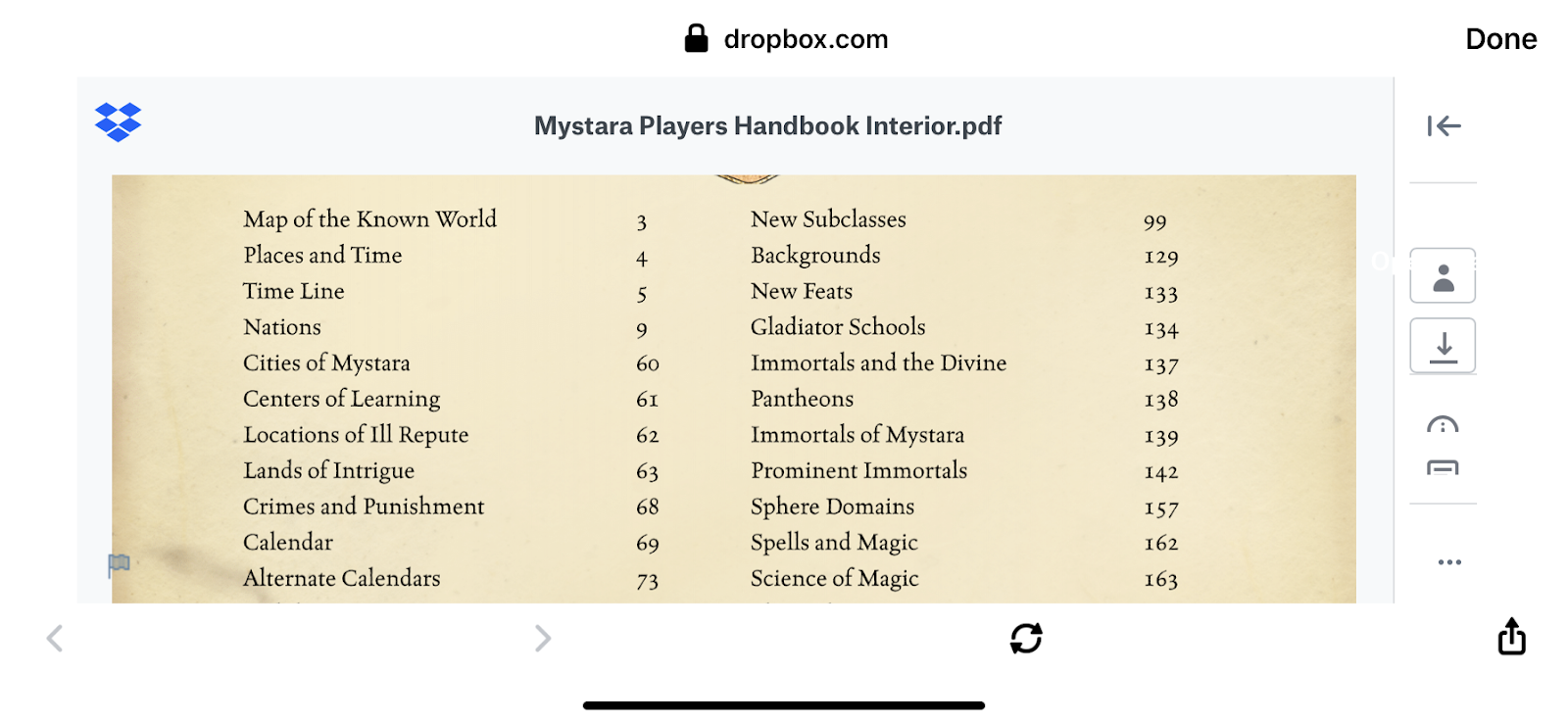
You can see the excerpts from the table of contents.

That comprehensive. Light on illustrations and filler. Heavy on context.

224 full sized pages of living, accurate and accessible content.

That comprehensive.


Friday, May 15, 2020

Heroquesting and the Godlearners Secret

It hit me that for a normal campaign to introduce heroquests it needs two things.

First is a myth that the question should follow.

Second is a structure that follows the bones that the godlearners discovered.

A heroquest involves:


  1. The call to adventure.  This is where the characters align themselves with the myth.  They achieve the right runic affiliations.  They acquire the appropriate regalia.  They align themselves with the correct community. They basically pay the entry fee for the quest.
  2. The stations of the quest.  This is where they retrace the path through myth in the footsteps of the hero.
  3. The reversal or loss.  This is where they now pay the price for the benefit that they are going to take back into the mortal realms.  This is why every heroquest has a reversal or failure built into it.
  4. The recovery or triumph.  This is where the characters overcome the reversal, converting the price they have paid into a benefit.
  5. The return.  This is where the characters return to the mortal realm from the mythic realm with the benefits they are bringing back for themselves and for their community.
The godlearners secret (not the official one that dooms you, but the secret to their power that Arachne Solara broke when she bound time) was that they learned to sidestep 3 by using the mythic realm to sidestep cause and effect.  While this increased entropy by minuscule cosmic amounts, it also allowed them to achieve great power.

Imagine all the benefits of Yelmalio or Humakt and none of the constraints.  Imagine being able to avoid the spirits of retribution.  To gain every benefit without paying the price.

Of course when Arachne Solara bound the sun, she also caused all the sidestepped debts to come due.  Which is why dooms found every godlearner no matter how they attempted to outrun them.  All of the delayed causality, all of the unpaid prices, all came due.  Since that mythic event, the sidestepping that they used also ceased to be available.  That secret is no longer relevant because it is not available.

A note on costs: costs are in the aggregate so that entropy does not increase.  But that means that if twenty heroquests attempt a path, if half of them fail in disaster, yielding up "payment" so to speak, and half succeed, the half that succeed can capitalize on the "payments" made by the half that failed.

If 100% of the heroquests on a path succeed, then each time at the step three reversal they will have to pay the price.  Consider how Yelmalio's followers all take penalties.

A note on costs:  costs may be paid by the community that supports the heroquest.  Lets say that one hundred members of the community each sacrifice a point of power.  The heroquest can achieve a result similar to the hero sacrificing a hundred points of power.

What a heroquest does is allow the community to achieve supramundane results that they couldn't reach, not results that it cannot pay for, by following or recreating the right path.

In designing heroquests:

  1. Pick a myth or a story.
  2. Work out the way that the characters can fit themselves to the story.
  3. Pick an outcome or benefit (the why they characters are going to do the quest).
  4. Fit the outcome or benefit to a price.
  5. Determine how and by whom the price is paid.
  6. Add in additional difficulty or wrinkles.
Sacred time each year is a two week community heroquest.  But the path is well trodden, the costs are well understood, the benefits in reducing entropy are clear.  Reviving Tada in Prax -- that hasn't been done yet, though the grisly portions, the runic identities and the path seems clear enough.

Anyway, it occurred to me that this is a different way to explain heroquests that might make it more accessible.

And no, you don't get the forbidden godlearner secret from this essay, just the one that was extinguished and the knowing of which is harmless.


On Alignment

The initial D&D campaign surfaced out of a Castles and Crusades Campaign.  The original alignments were based off of Three Hearts and Three Lions with Law = Civilized and Chaos = Feral.  Neutral was the borderlands between those two realms.

The next fantasy campaign was Barker's with Good/Evil for alignments, but the Good was stasis and the "Evil" was change.

At the same time, there was Moorcock's Law and Chaos with Law = Good and Chaos = Evil (and the chaos gods were worshiped with cries of "blood and souls" and similar things).  Of course Moorcock did not stay still, and his Law/Chaos eventually moved to Stasis/Change.  Moorcock's Neutral was exemplified by Tanelorn -- where people attempted to step aside from the wars of the gods.

My preference was Order / Chance (Tychism).  Though my law/chaos eventually shifted to Order (external rules) vs. Anarchy (internal whims).

In each of these the possibility of a good/evil axis also fits in.  Good can be defined a number of ways, but the two that fit fantasy campaigns are (1) seeking positive outcomes for the greatest number and (2) aligned with the positive energy planes -- both resisting entropy.

Evil is either (1) rapacious self serving action or (2) malicious action.  Both are aligned with the negative energy planes (or why all undead that energy drain end up evil) -- and increasing entropy.

For the most part, #1 is the general understanding of evil -- something that admittedly creates some tension with players who want to play #1 as neutral and assert that as long as their rapaciousness isn't malicious, it isn't evil.


Friday, October 25, 2019

Useful material

I've been posting useful material and FRPG related links to the Shattered Norns Facebook Group.

It is at:  https://www.facebook.com/groups/829726510438199/


Disclosure/Caveat:


Any time you share an affiliate link, it’s important to disclose that to your audience.

Note, I have affiliate links, it is just that as of Friday, October 25, 2019 all of them go to an account that does not exist.  That will eventually change and you should treat all links as if they are affiliate links going to an active account on Amazon.com.

As Amazon puts it:

Generally, readers trust you more if you are transparent about where you are directing them and why.

To meet the Amazon Associate Program's requirements, you must (1) include a legally compliant disclosure with your links and (2) identify yourself on your Site as an Amazon Associate with the language required by the Operating Agreement.


To comply with Federal Trade Commission (FTC) regulations, your link-level disclosure must be:

1. Clear. A clear disclosure could be as simple as “(paid link)”, “#ad” or “#CommissionsEarned”.
2. Conspicuous. It should be placed near any affiliate link or product review in a location that customers will notice easily. They shouldn’t have to hunt for it.


In addition, the Operating Agreement requires that the following statement clearly and conspicuously appears on your Site:

“As an Amazon Associate I earn from qualifying purchases.”

For social media user-generated content, this statement must be associated with your account.

Associates should also consider the relevant social media platform’s guidelines.

For example, Associates may use Facebook's Branded Content tool.


Visit this page on AC to bookmark this information about disclosures.
.
So, when I eventually get to creating links to my actual affiliate status, all of the above will apply. Treat any link you access after Friday, October 25, 2019 as being an affiliate link I am paid for, even if the truth is that I probably won’t them linking to an actual account before 2020.
Caution should be rule 1.

Any time you share an affiliate link, it’s important to disclose that to your audience.

Note, I have affiliate links, it is just that as of Friday, October 25, 2019 all of them go to an account that does not exist.  That will eventually change and you should treat all links as if they are affiliate links going to an active account on Amazon.com

Generally, readers trust you more if you are transparent about where you are directing them and why.

To meet the Amazon Associate Program's requirements, you must (1) include a legally compliant disclosure with your links and (2) identify yourself on your Site as an Amazon Associate with the language required by the Operating Agreement.


To comply with Federal Trade Commission (FTC) regulations, your link-level disclosure must be:

1. Clear. A clear disclosure could be as simple as “(paid link)”, “#ad” or “#CommissionsEarned”.
2. Conspicuous. It should be placed near any affiliate link or product review in a location that customers will notice easily. They shouldn’t have to hunt for it.


In addition, the Operating Agreement requires that the following statement clearly and conspicuously appears on your Site:

“As an Amazon Associate I earn from qualifying purchases.”

For social media user-generated content, this statement must be associated with your account.

Associates should also consider the relevant social media platform’s guidelines.

For example, Associates may use Facebook's Branded Content tool.


Visit this page on AC to bookmark this information about disclosures.
.
So, when I eventually get to creating links to my actual affiliate status, all of the above will apply. Treat any link you access after Friday, October 25, 2019 as being an affiliate link I am paid for, even if the truth is that I probably won’t them linking to an actual account before 2020.
Caution should be rule 1.

Saturday, January 27, 2018

Reflecting and projecting

January 26, 1985 is when I was married.

Fifteen years later, January 26, 2000 my life was in ruins in so many ways.  I was fat, 265 lbs.  I was fifteen years older.  Three of my children had died.  Physically I was a mess as well.

How bad?  Well, when I began the long slow road to physical health and started at a gym, I could move between 20 and 40 pounds on the machines, generally whatever the lowest setting was on the weight machines.  Walking even a mile was difficult for me.

It has been thirty-three years since January 26, 1985.  Fifteen years to disaster.  An interregnum.  And then rehabilitation. 

Now I weigh a good deal less.  I can walk fifteen or more miles, with a full backpack over the Appalachian Trail's ups and downs.  In so many ways things are so much better.

It came to mind as I read a story on Facebook that wrapped in someone who was looking at a shipwreck in many ways.  They were getting divorced, they were older and they had gained a lot of weight.

I reflected on that because I identified with them.  I tried to express that, but did so poorly.  Got told I was disgusting and fat shaming.  The people I was trying to talk to didn't get it.  I wasn't shaming the other person -- I had been in their shoes -- and I wasn't claiming sympathy as an excuse to deride them.  I had been that person whose world had crashed apart.

But, things are better now.  I was lucky enough not to face divorce (though burying three children in the space of five years was terribly hard and the death of so many dreams).  I lost the academic career I had been building towards with publications and seminar presentations.  If you've been 5'5" and 265 pounds with no muscle tone at all you know I was a mess.

It is a terrible place to be.  Yet. 

Yet.

Yet yesterday, January 26, 2018 I was glad to be alive.  Today, January 27, 2018 I am glad to be alive.  There is so much joy possible.  The person I was commenting on seems to see that, I hope that they mean what they wrote.

But it was good for me to look back and see myself in their shoes as well.

Thursday, September 28, 2017

Falls the shadow.


Falling Shadow

Parts:

1.       Building a road through dream.
a.       Dream terrain:
                                                               i.      Real/fixed
                                                             ii.      Fanciful
                                                            iii.      Mutable.
b.      Dream weather:
                                                               i.      Fear
                                                             ii.      Hope
                                                            iii.      Passion
                                                           iv.      Memory
                                                             v.      Loss
                                                           vi.      Confusion
                                                          vii.      Peace.
c.       Dream Encounters
d.      Dream Inhabitants.
                                                               i.      Aberrations.
                                                             ii.      Shadows.
                                                            iii.      Dreams.
                                                           iv.      Creatures.
                                                             v.      Clockworks.
e.      The anchors and road way.
2.       Falls the Shadow City
a.       The factions
b.      Typical city encounters and issues – all five have cross-purposes and alignments. (each needs two out of three things).
c.       Journey from West Anchorage to Redoubt short of the City.
d.      Embassy seeking cooperation in seeking a bending on the gate to allow the dream road to pass through to the mountains.
                                                               i.      Master’s position is that if they can get three factions, he can make it happen.
                                                             ii.      Two factions support.
                                                            iii.      Need to gain a third, without losing any of the two.
                                                           iv.      Offers.
                                                             v.      Encounters.
                                                           vi.      Reversal.
                                                          vii.      Redoubt in Mountains.
                                                        viii.      Anchor set or failure.
                                                           ix.      Other possibilities. 
                                                             x.      Return or other choices.
1.       Redoubt in mountains can anchor to Star strands location permanently.
2.       They can choose to stay in City.
3.       They can return to West Anchorage, either by road, overland, or through Star strands.

Island Adventures
1.       Starting campaign in the islands.
2.       Character generation.
3.       Initial campaign choices and missions.
a.       Explore
b.      Harvest
c.       Pacify
d.      Oppose Kraken discharges.
e.      Hunts.
f.        Delving in ruins.
g.       Cross-Island possibilities.
h.      Cross over to shadow in unsettled areas.
4.       Launching to Ostend.


Sunday, September 10, 2017

Fixing my wiki entry

If anyone can help, I'd appreciate it.


          That is the way it should be.  Some bizare edits have been made.


            For example, I was born in Los Angeles County, but that has been deleted. I did live in Las Vegas, but I graduated High School from Mountain Home, Idaho. I lived four years in Alaska (the longest of any place I lived until I got married).  Not that big of a thing but perplexing.

          More strange is the fact that someone edited my page to make it look like I went to TSR while I was doing my undergraduate work rather than in the summer after my first year of law school.

          I graduated from CSULA in 1979 and started law school in 1979.  Went to TSR in 1980 (where I wrote the Expert Set -- Zeb Cooki did the real editing, *without* computers, and made the Expert Set line up page for page with the prior rules so you could put them in a loose leaf binder and swap out pages if you wanted to -- something a number of people thought would be impossible to do by the deadlines).

          2016 did have have a reprise of City of the Revenant and the Planes of Fire and Ice.  2017 had the City of the Revenant, An OD&D scenario and one other (I ran three for 2017).

           I section hike the Appalachian Trail with the trail name of "d20" and my wife uses "Happy"

         I've tried to fix the wiki page a few times, the bots always revert.


Thursday, April 21, 2016

Pre-OSR System for NTRPG Con Across the Sea of Stars

Pre-OSR System

All Damage comes from one of three sources:
Magic
Combat
Physical Environment.

Three character classes:

Fighters
Mages
Cleric/Harpists

Each character has 1d6 per level, characters are measured by HD.  For the convention, everyone has a 6HD character.

In a melee round, a character allocates their HD.  A fighter  usually allocates all HD to attack, so a 6HD fighter would roll 6d6 in the attack.
A mage can allocate HD to magic effects or cast a spell.
A cleric can attack in combat or can allocate HD to restore others or to affect Undead or to clerical effects.


Combat:
Mages can wear light armor, use light weapons.
Clerics can wear medium armor, use shields and use medium weapons.
Fighters can wear heavy armor, use shields and/or use heavy weapons.

Light armor +0        Light weapon can have +1 to Attack or +1 to Defense  (mages)
Medium armor +1   Medium weapons split 2 points between Attack and Defense.
Heavy armor +2       Heavy weapons (2H weapons) are +3 on Attack
Shield is +1
Missile weapons -1Hd per 10’ of range covered by missile.
Magic missiles (such as a magic arrow) do not lose HD for range.

Magic user weapons are the following.
Dagger:          +1 Magic, +1 in combat Attack
Wand:                        +2 Magic, +0 in combat attack.
Staff:               +1 Magic, +1 in combat Defense

Some examples.

Frederick of the Hills is a 6HD Dwarf Fighter.  He wears heavy armor (+2 on defense) and uses a medium weapon (an axe, +2 on attack).  He is facing a 3HD Orc in light armor with a light weapon (+1 attack, fire hardened spear).

The highest HD character attacks first.  Otherwise roll d6+Dex to see who goes first.
Frederick rolls 6d6.  Since he is using a battle ax, he adds +2 to each roll.

In defense, the orc rolls 3d6.  With light armor, he adds +0 to each roll.

Let us suppose Frederick rolls 6, 5, 4, 3, 2, 1.  That becomes 8, 7, 6, 5, 4, 3.

The Orc rolls 6, 6, 6.  8>6 so the Orc is down to 2 HD.  7>6 so the Orc is down to 1 HD.  6 = 6 so the Orc doesn’t lose that HD. 5>0 (Orc is only 3 HD) so the Orc loses another HD is now 0 hit dice and incapacitated.  4>0 and the Orc is dead.

Had the Orc had surprise and gotten to go first, let us assume 6, 6, 6.  Frederick rolls 6, 5, 4, 3, 2, 1.  With +2 on his armor, that becomes 8, 7, 6, 5, 4, 3.  With +1 for the spear, the Orc gets 7, 7, 7.  8>7 so no effect.  7=7 so no effect.  7>6 so Frederick loses 1 HD and only gets to roll 5 HD for his counter-attack on the Orc.

Mages:

Spells:
First Level     Stun area (sleep)
Second Level Stun single target (charm/hold)
Third Level   Damage area with mage’s element
Fourth Level Damage with alternative element
Fifth Level    Specials

Effects (affects are limited to HD effects of ½ the HD of the character)
            1HD Effects
                                    Detect Magic
                                    Hold Portal
                                    Read Magic
                                    Read Languages
                                    Light
            2 HD Effects (uses 2HD)
                                    Detect Invisible
                                    Levitate
                                    Locate Object
                                    Invisibility
                                    Detect Evil
            3 HD Effect
                                    Fly
                                    Dispel Magic
                                    ESP/Clairvoyance
                                    Infravision
                                    Protection normal missiles.
                                    Water Breathing

Attack Spells
                        1st         2nd       3rd       4th        5th
1HD                1
2HD                2
3HD                3          1
4HD                4          2
5HD                4          2          1
6HD                4          2          2
7HD                4          3          2          1
8HD               4          3          3          2
9HD                4          3          3          1          1

Area spells affect all in an area.  The HD are divided between all the targets.  So, a 3HD mage who casts sleep, gets a 3HD attack on all in the target area.  If three Kobalds of 1d3 each in the area, the mage would roll 1d6 against each Kobald.


Harpist/Clerics

Assume a 6HD cleric in combat, armed with a Mace.  They could strike a foe with a 6HD attack in melee.  They could use 3HD for a 3HD effect and use 3HD to support another character (in either attack or defense).  They could use 2HD for a 2HD effect, use 2HD to heal another character and use 2HD against an undead creature.  Or any similar breakdown.

Effects (affects are limited to HD effects of ½ the HD of the character)
            1HD Effects
                        Purify food & water
                        Detect Magic
                        Detect Evil
                        Light
            2HD Effects
                        Find traps
                        Speak with animals.
                        Silence 15’ from caster.
            3HD Effects
                        Remove Curse
                        Cure Disease
                        Speak with recently dead.

Vs. Undead  Roll HD.  Double the roll and apply in an attack at up to HDx10’ against the undead.  Thus 4d6 would become 4d(2d6).  On a push, if the Undead has no hit dice left other than ones remaining from the push, the undead flees.

Pre generated Characters (pre-OSR)

Human Cleric

STR     9
DEX    15
Con     13
INT     14
WIS    18
CHA    11
Medium Armor
Shield
Mace (+2 attack) +1 Magical in attack, +2 when attacking undead in combat or by dispel.
Has a llama

Fae/Elf Harpist

STR 12
DEX 16
CON 14
INT 13
WIS 17
CHA 12
Medium Armor
Harp (functions as a shield and as a weapon +2 to defense, +1 magic to defense in combat or magic, +2 when dispelling undead).
Has a llama


Mage Human/Earth

STR 10
DEX 14
CON 13
INT 18
WIS 10
CHA 13
Ring of +1 to defense against magic
Uses a staff, which is magical, +1 to combat defense, +1 to magical attacks.
Has a llama


Mage Korlinth/Air

STR 8
DEX 14
CON 14
INT 18
WIS 14
CHA 8
Ring of +3 to CHA
Uses a dagger, enchanted to +1 to combat attacks, +1 to magical attacks.
Has a llama


Frederick of the Hills, Dwarf Fighter

STR 19
DEX 11
CON 16
INT 10
WIS 10
CHA 12
Heavy Armor, +1 enchantment to defense
Heavy Weapon, two handed ax, enchanted to +1 on attacks.
Dwarf, adds +1 to rolls vs. physical hazards
Has a clay mule construct


Arkat Dark-Breaker, Human Fighter

STR 16
DEX 10
CON 15
INT 12
WIS 10
CHA 16
Heavy Armor, +1 enchantment to defense
Shield, +1 enchantment to defense, +1 to defense from magic
Medium weapon, battle sword, +1 to defense, +1 to attack, enchanted +1 to attack.
Has a llama.


Fighters also have swarm ability when fighting from a mount that has swarm capability (other character types do not).

Llamas are 2HD, move as a medium horse, carry encumbrance as a light horse, swarm
Clay mule is 4HD, move as a medium horse, carry as a heavy horse, cannot swarm.